Japan in a Campervan: Our Practical Tips for 2 People
Here are our hands-on experiences for two people traveling in a Nissan DUO. What you actually need, how to clear uncertainties, and how to tour Japan with absolute peace of mind.
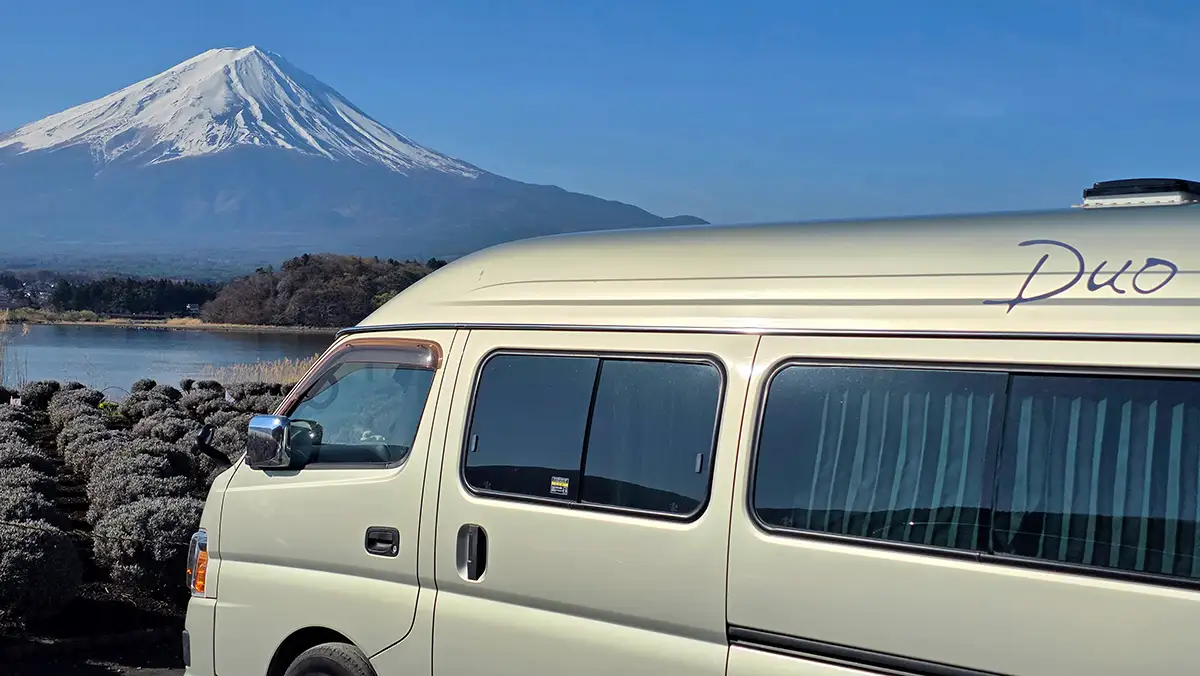
The Nissan Duo: Our Vehicle Choice
For our journey through Japan, we chose the Nissan Classic "Duo" from Japan Campers. Not having to hunch over all day inside a compact camper—especially during bad weather—was well worth the moderate long-term price difference compared to smaller vehicle classes (such as Kei-cars).
The Nissan Duo is based on the classic Nissan Caravan series. On the rental company's website, it is listed at 2.30 m in height—while right on the dashboard inside the cockpit, a sticker indicates 2.28 m. Thanks to the GRP high roof, its interior standing height is a just-about-acceptable 1.60 m. The dinette remains cozy for extended periods even in rainy weather. In the evening, the seating group easily converts into a bed—reminiscent of a classic VW bus or Mercedes Marco Polo.
- Base Vehicle
- Nissan Caravan (Classic Series)
- Stated Height
- 2.30 m (Web) / 2.28 m (Sticker)
- Interior Standing Height
- approx. 1.60 m
- Occupants
- 2 seating & sleeping berths
- Bed Dimensions
- approx. 1.50 × 1.80 m (converted)
- House Battery
- 100 Ah Lithium (Dual System)
- Kitchen Equipment
- 1-burner gas stove & 12V fridge
- Heating
- Built-in Webasto auxiliary heater
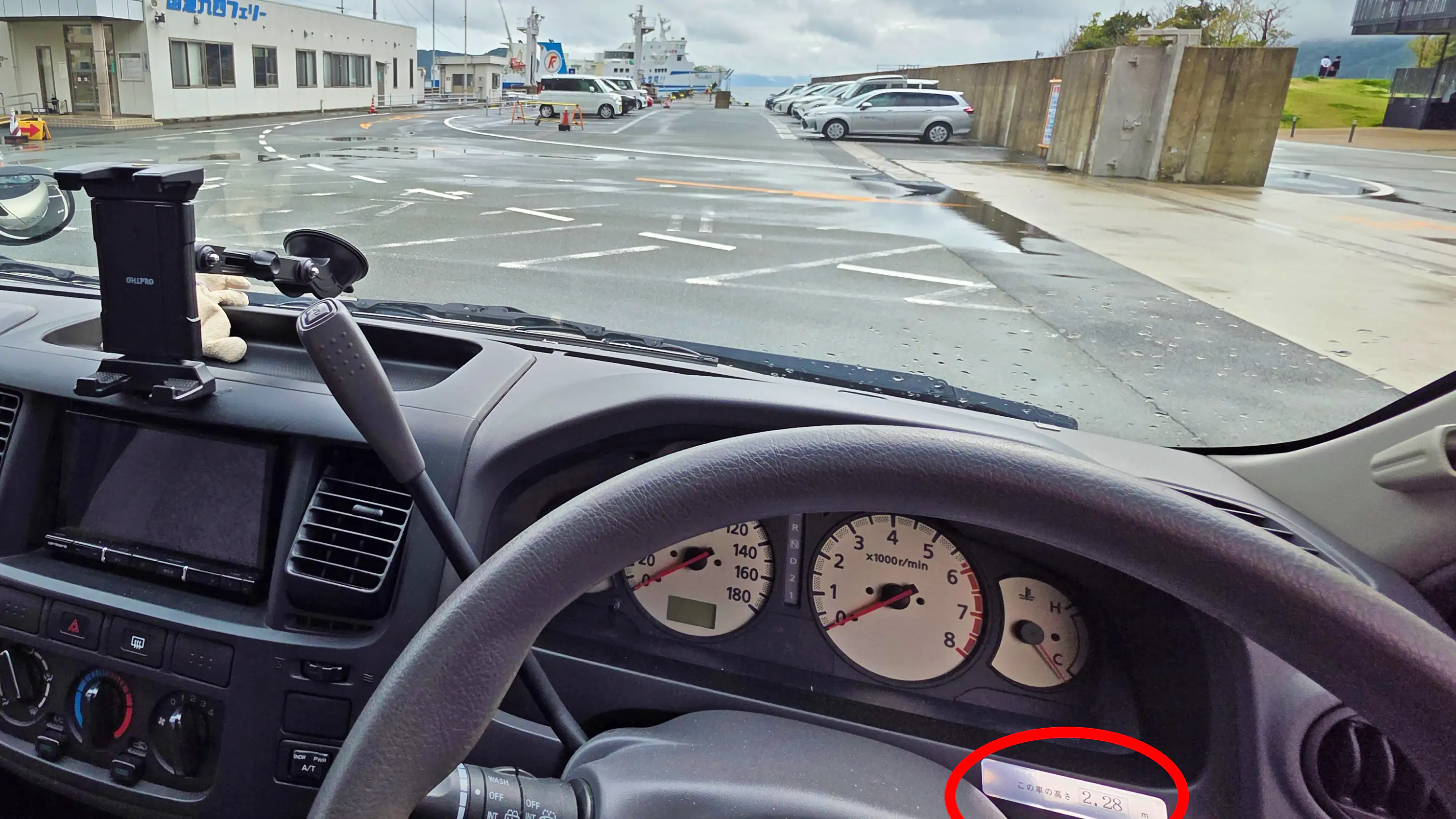
Important Practical Note on Vehicle Height for Parking Lots & Barriers (2.30 m): Upon inquiry, the rental company explained that the retrofitted roof vent can add a few extra centimeters in everyday use. At exact 2.30 m height clearances (commonly found at supermarkets), things get uncomfortably tight—especially if you happen to forget to close the roof vent completely. Relying blindly on signs or the cockpit sticker can therefore be risky. Our proven approach: stop briefly before tight barriers, let the passenger step out to live-check the clearance from the outside. We consistently avoided multi-story parking garages (due to low-hanging sprinklers or pipes) and instead headed directly for open parking areas.
Our Nissan was no brand-new vehicle: the rental company explicitly describes the Classic Duo fleet as proven utility vehicles—typically over 15 years old with more than 150,000 km on the odometer. Thanks to solid maintenance and modernized camping equipment (like the lithium house battery), the van reliably accompanied us for nearly 4,000 km.
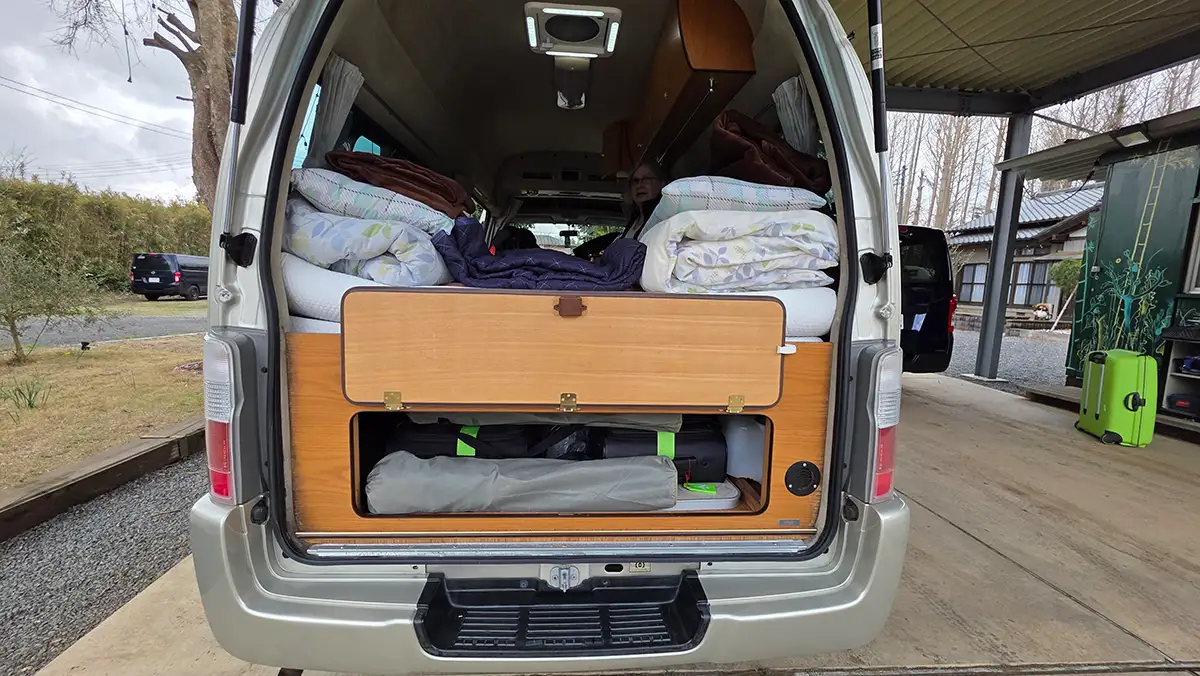
- Mattress Topper Tip: Always ask the rental company for a mattress topper free of charge—it drastically increases sleeping comfort on the cushion puzzle.
-
Daiso Purchase – e.g. Plastic Clothes Hangers: Grab 4–5 plastic clothes hangers right at the start at Daiso (or another 100-yen shop). Since the Duo lacks a proper wardrobe, you can easily hang daytime clothes on the rail of the overhead cabinet. At night, the hangers simply move up front into the cab.
Politely ask Japan Campers if you can take two of the typical transparent Japanese umbrellas left behind by previous renters. If none are available, buy them at Daiso. - Rear Storage Compartment under the Bed: Offers plenty of space for the provided camping table and folding chairs. Additionally, two flight cases fit inside, packed with essentials for hotel nights in Tokyo, Kyoto, Hiroshima, or elsewhere. Even souvenirs, spare shoes, or backup gas canisters found a home there without any issues. Large hard-shell suitcases are stored safely and free of charge in the rental depot during the trip.
Cooking in the Van: Single-Burner Stove & Food Markets
Plunging into the "food adventure world" of huge supermarkets means you can whip up gourmet experiences right on board with a single-burner stove. A single gas canister lasted us about 7 days, e.g., for coffee and scrambled eggs in the morning and a quick pan-fried dish in the evening. Our first canister was provided free by the rental company, so make sure to look out for refills early on!
If you rely mostly on Konbini offerings, you will probably only need the stove for coffee and your supplies will last even longer.
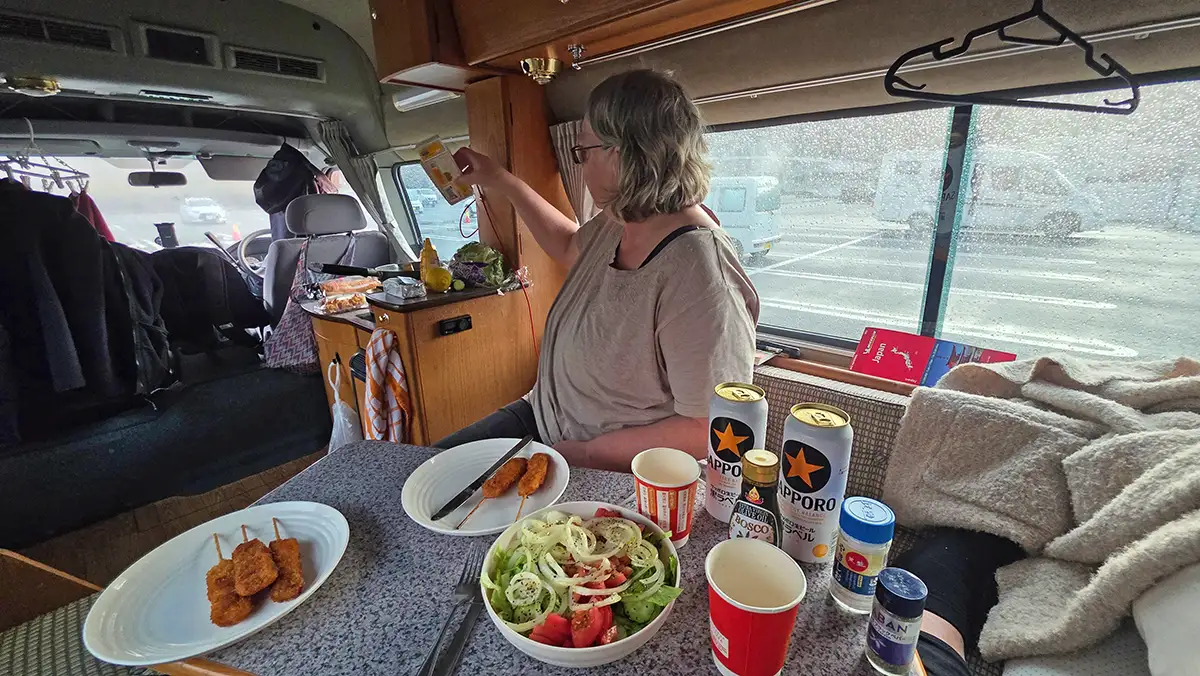
Anyone searing seafood or meat inside a compact van should keep in mind that rental companies charge an extra cleaning fee for lingering odors. For us, this was a non-issue thanks to proper ventilation: a roof hatch with a fan is built right in—combined with the small auxiliary intake/exhaust vent in the rear, the system creates great airflow. Cooking steam is drawn straight up and out to the back, even when weather closes in outside.
Michi-no-Eki: Sanitation, Rainy Nights & Travel Urinal
Visiting the virtually always impeccably clean Michi-no-Eki restrooms at night—even in pouring rain—is definitely an option.
However, we opted for a "slightly different" setup:
- ♂️ … A travel urinal inside an opaque fabric pouch is an extremely relaxed solution at night inside the van and can be discreetly emptied the next morning in the Michi-no-Eki restrooms.
- ♀️ … Porta Potti (provided free of charge by the rental company), saving you from walking across half the parking lot in pyjamas through wind and weather (alternatively, a female urination device like a *Urinella* works too).
During the day, you use the spotlessly clean, free restrooms at Michi-no-Eki or convenience stores anyway... Since the small Porta Potti is used solely during nighttime hours, it means you rarely need to head to an official RV park or campground to dump it.
Greywater Minimization: The Zewa & Two-Cloth Method
To avoid burdening our 20-liter greywater tank in the first place, we followed this routine:
- Fat & Residue: Food scraps and greasy oil were consistently wiped off prior to washing using paper towels (Zewa) and disposed of in the general trash. This kept pans, pots, cups, and plates... almost completely clean.
- The Microfiber-Cloth Method: Cooking was done with minimal water (e.g., pre-cooked noodles pan-fried with just a splash of water). For washing up after "wipe and go," we used a microfiber cloth with a tiny drop of dish soap and a drying towel.
- Rinsing Out: The microfiber cloth was simply rinsed out and wrung out thoroughly in the Michi-no-Eki basin in the morning—just like locals naturally do with their morning face and hand towels. It blends in completely unnoticed, as long as you leave the basin spotless.
With this minimalist, chemical-free system, the roadtrip runs completely stress-free, bypasses all gray areas, and flows smoothly through everyday Japanese life.
When it came to waste disposal, our guiding principle was simply Meiwaku – causing no unnecessary inconvenience to others. We wanted to leave every place just as we would wish to find it—if not cleaner. For instance, we picked up and discarded scattered scraps of thin Japanese toilet paper left behind by previous visitors. Leaving no visible trace whatsoever was important to us.
Bunkering Fresh Water Without Hose Hassle
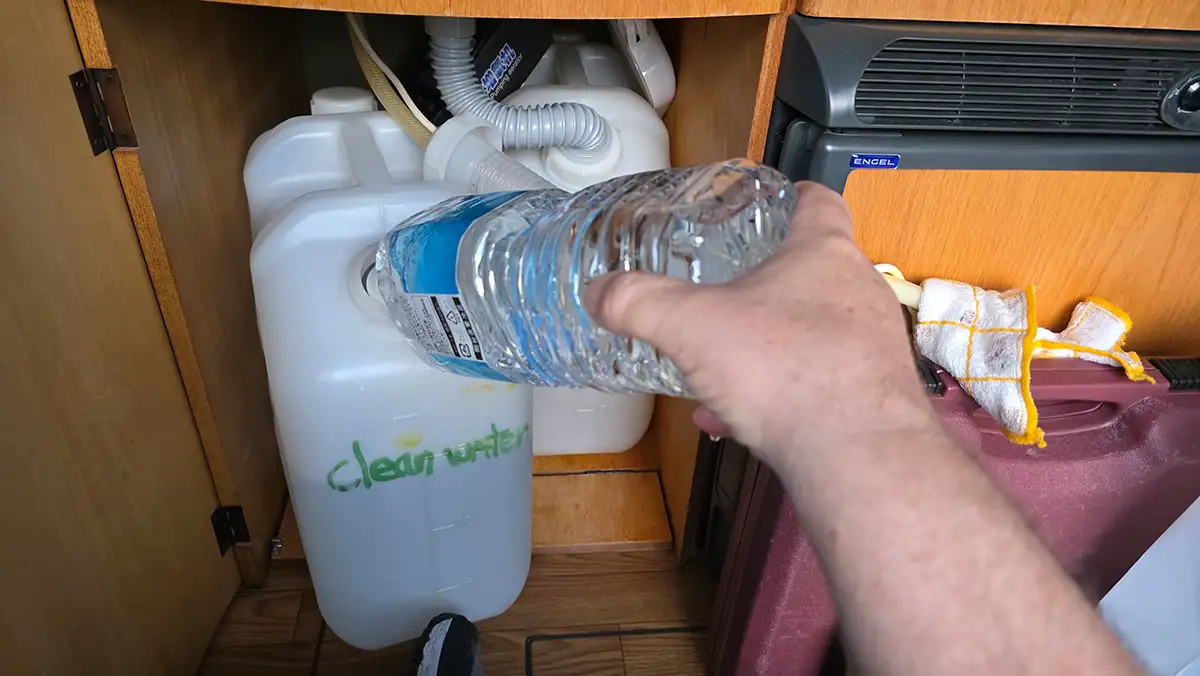
Bunkering fresh water – instead of fussing around Michi-no-Eki restroom facilities with the motorhome's 20-liter canister, use two 1.5-liter PET mineral water bottles. Fill them at regular restroom washbasins and pour them into the kitchen tank inside the van. Inconspicuous, clean, and perfect for daily needs.
Japan has exceptional tap water straight from the mains. But since you never know how a previous renter maintained the van's canister, we use canister water for dishwashing, cooking, coffee/tea water, and brushing teeth. For pure drinking water, we use PET drinking water bottles that can be easily refilled at public water dispensers.
Waste Disposal on the Road
Waste disposal – yeah, it takes some getting used to finding out where to drop it. But you quickly get the hang of it, figuring out which corner the sorting bins are tucked into at Michi-no-Eki or supermarkets. At Lawson, 7-Eleven, and FamilyMart Konbinis… they are usually found inside the store. It can sometimes take a little while to locate a bin, meaning you have to store trash temporarily in the van until then.
The fact that some people just dump their trash anywhere in the Michi restroom area... unthinkable!
Electronics, Cables & Onboard Power
- Bring a 2m USB-C Cable: Up front, the free iPad and mini-router use both charging ports. A phone can thus be conveniently charged up front or in the back using the kitchen charging ports.
- World Travel Adapter: Must feature the correct Type A configuration to operate European 230-volt devices... Type B with the round grounding pin will not fit!
- 100 Ah Lithium House Battery: For us, the 100 Ah lithium battery easily kept the fridge running continuously for three nights while we enjoyed a hotel stay in Tokyo, Kyoto, etc. The app installed by the rental company on your phone displays the battery state of charge including remaining runtime projections.
ETC Toll Card & The Moment at the Toll Barrier
ETC – as practically every tip-giver writes – is a must-have. Yeah... but what do you do when the barrier doesn't open and someone is already right behind you?
If available, use the combined ETC/paper ticket lanes... that way you can pull a paper ticket in an emergency.
Happened to us: ETC card slipped out of its holder, barrier wouldn't open, pulled a paper ticket, parked right before the exit between two portals, and a staff member immediately came sprinting out to help us operate the super-complicated payment machine... phew!
Rental Support: The Little Difference
You arrive, travel in a foreign country, and stumble across issues. For example, our free airport pickup after arrival was scheduled within business hours—only for someone else to mistakenly take our suitcase off the conveyor belt ☹. That cost us 45 minutes until the traveler was called back with our luggage. Our rental provider waited for us past closing time without a fuss. The shuttle bus was then provided for an extra fee—thanks to the numbskulls, a.k.a. luggage thieves! 😄 Our driver kindly stopped briefly at a 7-Eleven Konbini for cash and dinner/breakfast snacks.
Support on the road was equally straightforward: When we had an issue with the ETC card, the rental team helped via WhatsApp video assistance. When the DUO suddenly started making a grinding noise, we quickly sent a video. Our guess: maybe a tiny stone stuck between brake pad and brake rotor? Yep – happens. Their tip: drive in reverse for a short distance. Done – noise gone. We already knew that trick from our own motorhome. Phew, problem solved.
We also appreciated the free airport transfer during office hours and the option to use the guesthouse upon arrival and departure for long-term rentals.
A Few Japanese Words to Break the Ice
Beyond mandatory greetings, we found it helpful to keep a few short single-word expressions handy. No language lesson—just small words that work instantly in everyday life. Feel free to pick out a few matching terms beforehand.
| Category | Japanese (Pronunciation) | Meaning / Effect |
|---|---|---|
| 🍱 Restaurant & Bar | Uma-sugi! (Oomah-soogih) | Too delicious! |
| 🏨 Hotel & Service | Sugo-i! (Ssoo-goh-ih) | Incredible! / Awesome! |
| 🛍️ Shopping | Ii ne! (Ee-neh) | Nice! / I like it! |
| ♨️ Onsen | Kimochi ii! (Kee-moh-tchee ee) | Feels so good! |
| 📸 Sightseeing | Ii desu ka? (Ee dess kah) | Allowed? / Okay? (Point to camera) |
| 🚶 Everyday & Contacts | Sumimasen! (Soo-mih-mah-ssen) | Excuse me! / Thank you! |
| 🚶 Everyday & Contacts | Gomen! (Goh-men) | Sorry! (After bumping into someone) |
Souvenirs: Our Highlights to Take Home
Suitcase Tip Upfront: Don't pack your suitcase too full on the outbound flight—you'll need space for souvenirs on the way back!
- Adjustable Kyocera Cabbage Shredder: This tool makes wafer-thin shredded cabbage for the typical fresh coleslaw side dish served everywhere in Japan.
- Hand-Engraved Kitchen Knife: Not from a flashy tourist shop, but from a rustic Kyoto knife store directly stamped and engraved with personal Kanji by an old master using hammer and punch.
- Seeds & Everyday Bits from Konbini & Daiso: Cucumber and bean seeds for the home garden, small Umeshu plum wine in a glass jar from the Konbini, and nice sake tableware from the 100-yen shop.
- The Ultimate Kitsch: A straw-wrapped mini sake cask (Kazaridaru). Completely over the top, but simply a brilliant eye-catcher on the shelf at home.
Want even more insights?
Check out the full story in our Polarsteps travel journal! ➔